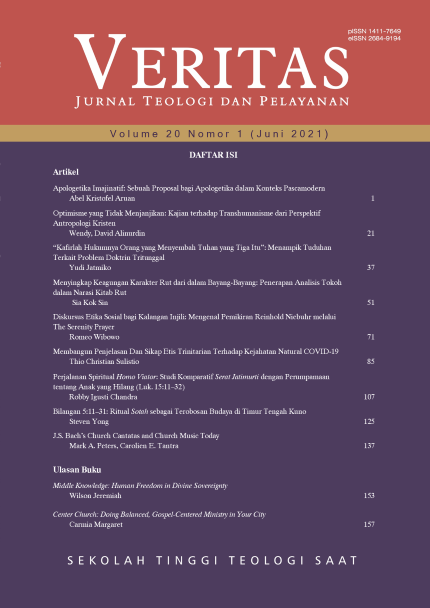
Bilangan 5:11–31: Ritual Sotah sebagai Terobosan Budaya di Timur Tengah Kuno
DOI:
https://doi.org/10.36421/veritas.v20i1.471Kata Kunci:
Bilangan 5:11-31, Sotah, Zina, Timur Dekat Kuno, SeksismeAbstrak
Bilangan 5:11–31 dapat menimbulkan kecurigaan tentang adanya praktik seksisme, penindasan atau pelecehan terhadap wanita. Hal ini bisa dimengerti jika Mishnah menjadi rujukan yang kemudian dijadikan tolok ukur untuk menafsir bagian Alkitab terkait. Dari penggambaran Mishnah Sotah, wanita yang tertuduh melakukan zina dipermalukan dan diperlakukan hampir sama seperti seorang pelacur. Artikel ini berusaha untuk menunjukkan perspektif yang lain dalam mengerti ritual Sotah dalam Bilangan 5:11–31. Dengan menggunakan metode kajian sosiologis, artikel ini akan mengidentifikasi masalah sosiologis yang dituduhkan terhadap teks Bilangan tersebut berdasarkan penjelasan traktat Sotah dalam Mishnah. Kemudian, posisi wanita dalam dunia Timur Dekat Kuno akan dijelaskan berdasarkan konteks budayanya. Akhirnya, dengan menimbang inferioritas wanita dalam dunia Timur Dekat Kuno dan perbandingan antara ritual Sotah dalam Alkitab dengan ritual sejenis dan setempat, maka artikel ini berargumen bahwa teks Bilangan 5:11–31 dapat dilihat sebagai terobosan budaya dalam membela wanita yang secara budaya pada masa itu dianggap sebagai kaum yang inferior.
Unduhan
Referensi
Alpert, Rebecca T. “The Sotah Revisited.” The Reconstructionist 53 (1988): 32–33.
Amzallag, Nissim dan Yona, Shamir. “The Kenite Origin of the Sotah Prescription (Numbers 5.11-31).” Journal for the Study of the Old Testament 41 no 4 (2017): 383–412. DOI: https://doi.org/10.1177/0309089216661176
Ashley, Timothy R. The Book of Numbers. NICOT. Grand Rapids: Eerdmans, 1993.
Biale, Rachel. Women and Jewish Law: An Exploration of Women’s Issues in Halakhic Sources. New York: Schocken, 1984.
Brichto, Herbert Chanan. “Case of the Sota and a Reconsideration of Biblical ‘Law’.” Hebrew Union College Annual 46 (1975): 55–70.
Briggs, Richard S. “Reading the Sotah Text (Numbers 5:11-31): Holiness and a Hermeneutic Fit for Suspicion,” Biblical Interpretation 17, no. 3 (2009): 288–319. https://doi.org/10.1163/156851508X329665. DOI: https://doi.org/10.1163/156851508X329665
Brown, Francis, S.R. Driver dan Charles A. Briggs. The Brown-Driver-Briggs Hebrew and English Lexicon. Peabody: Hendrickson, 1994.
Clines, David J.A. Dictionary of Classical Hebrew. 9 Vol. Edisi revisi. Sheffield Academic Press, 2016.
Fishbane, Michael. “Accusations of Adultery: A Study of Law and Scribal Practice in Numbers 5:11–31.” Hebrew Union College Annual 45 (1974): 25–45.
Gruschcow, Lisa. Writing the Wayward Wife: Rabbinic Interpretations of Sotah, Ancient Judaism and Early Christianity 62. Leiden: Brill, 2006. https://doi.org/10.1163/9789047417811. DOI: https://doi.org/10.1163/9789047417811
Hauptman, Judith. Rereading the Rabbis: A Woman’s Voice. New York: Routledge, 2018. DOI: https://doi.org/10.4324/9780429497650
Pritchard, James B., ed. Ancient Near Eastern Texts Relating to the Old Testament. Princeton: Princeton University Press, 1969.
Pritchard, James B., ed. The Ancient Near East: An Anthology of Texts and Pictures. Princeton: Princeton University Press, 1958.
Budd, Philip J. Numbers. Vol. 5. WBC. Waco: Word, 1984.
Danby, H., ed. The Mishnah. London: Oxford University Press, 1933.
Driver, G.R. “Two Problems in the Old Testament Examined in the Light of Archaeology” T. 33 Fasc. 1/2. Syria (1956): 73–77. DOI: https://doi.org/10.3406/syria.1956.5184
Frymer-Kensky, Tikva. “The Strange Case of the Suspected Sotah” 34 no. 1. Vetus Testamentum (1984): 11–26. https://doi.org/10.1163/156853384X00025. DOI: https://doi.org/10.1163/156853384X00025
Harper, Robert Francis. The Code of Hammurabi: King of Babylon about 2250 B.C. Chicago: University of Chicago Press, 1904. DOI: https://doi.org/10.1086/369501
Levine, Baruch. Numbers 1–20: A New Translation with Introduction and Commentary. Anchor Bible Commentary. New York: Yale University Press, 1993. DOI: https://doi.org/10.5040/9780300262087
MacDonald, Elizabeth Mary. The Position of Women as Reflected in Semitic Codes of Law. Toronto: University of Toronto Press, 1931.
Marsman, Hennie J. Women in Ugarit and Israel: Their Social and Religious Position in the Context of the Ancient Near East. Leiden: Brill, 2003. DOI: https://doi.org/10.1163/9789004493407
McKane, William. “Poison, Trial by Ordeal and the Cup of Wrath” 30 no. 4. Vetus Testamentum (1980): 474–492. https://doi.org/10.1163/156853380X00434 DOI: https://doi.org/10.1163/156853380X00434
Rosen-Zvi, Ishay. The Mishnaic Sotah Ritual: Temple, Gender and Midrash. Supplements to the Journal for the Study of Judaism. Leiden: Brill, 2012. DOI: https://doi.org/10.1163/9789004227989
Unduhan
Diterbitkan
Cara Mengutip
Terbitan
Bagian
Lisensi
Hak Cipta (c) 2021 Steven Yong

Artikel ini berlisensiCreative Commons Attribution-NonCommercial-ShareAlike 4.0 International License.