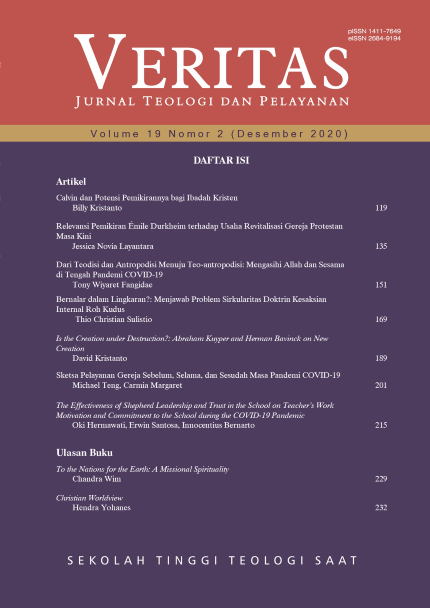
Dari Teodisi dan Antropodisi Menuju Teo-antropodisi: Mengasihi Allah dan Sesama di Tengah Pandemi COVID-19
DOI:
https://doi.org/10.36421/veritas.v19i2.372Kata Kunci:
Teodisi, Antropodisi, Teodisi Etis, Teo-antropodisi, Leibniz, Sontag, Levinas, COVID-19, PenderitaanAbstrak
Dunia sedang berhadapan dengan pandemi COVID-19 yang menyebabkan penderitaan di beberapa aspek kehidupan manusia seperti kesehatan, sosial, ekonomi, psikologis, hingga religius. Polemik ini menghantar kita pada diskusi seputar teodisi. Teodisi merupakan paradigma yang digunakan Leibniz untuk membela kemahabaikan dan kemahakuasaan Allah di hadapan realitas penderitaan, tetapi teodisi cenderung berhenti pada ranah teori tanpa praktik. Sontag mengusung paradigma antropodisi dalam wujud solidaritas sosial yang mengedepankan praktik untuk mengkritik teodisi yang terlampau abstrak dalam membela Allah tanpa mempedulikan penderitaan manusia. Antropodisi tampaknya terlalu sosialis dan cenderung berpegang pada kemampuan manusia, sehingga mengeksklusi aspek religius dalam solidaritas sosial. Levinas merespons kegelisahan ini dengan mengusung teodisi etis. Paradigma teodisi etis digunakan Levinas untuk memperlihatkan kehadiran Allah melalui manusia yang bertanggung jawab terhadap penderitaan sesamanya. Artikel ini mengusulkan nama, pemaknaan, dan pengembangan baru terhadap teodisi etis, yaitu teo-antropodisi, sebagai paradigma yang merangkul teodisi sekaligus antropodisi. Teo-antropodisi mengorelasikan teori dan praktik tersebut sama seperti iman (teodisi), tanpa perbuatan (antropodisi) adalah mati. Teo-antropodisi berfondasikan prinsip “mengasihi Allah dengan segenap hati, jiwa dan akal budi” serta “mengasihi sesama manusia seperti diri sendiri.”
Unduhan
Referensi
Avani, Shahin. “Theodicy or Divine Justice in Leibniz.” Journal of Philosophical Investigations 14, no. 30 (2020): 1–10.
Arthur, Richard T.W. Leibniz. Classic Thinkers. Cambridge: Polity Press, 2014.
Atterton, Peter. “Levinas’s Humanism and Anthropocentrism.” Dalam Oxford Handbook of Levinas, diedit oleh Michael Morgan, 710-731. Oxford: Oxford University Press, 2018. DOI: https://doi.org/10.1093/oxfordhb/9780190455934.013.10
Backus, Irena Dorota. Leibniz: Protestant Theologian. Oxford: Oxford University Press, 2016. DOI: https://doi.org/10.1093/acprof:oso/9780199891849.001.0001
Damar, Vincentius. Kejahatan dalam Dunia yang Terbaik. Yogyakarta: Kanisius, 2016.
Fangidae, Tony Wiyaret. “Gambar Allah Menurut Kejadian 1: Sebuah Penolakan Terhadap Alienasi Subjek Dan Domestikasi Gambar Allah.” Jurnal Theologia in Loco 2, no. 1 (2020): 91–117.
Farley, Lisa. “Useless Suffering: Learning from the Unintelligible and the Re-Formation of Community.” Interchange 35 (2004): 325-336. https://doi.org/10.1007/BF02698881. DOI: https://doi.org/10.1007/BF02698881
Fleming, Daniel J. “Flight, Emmanuel Levinas, and the Critique of Theodicy.” The Journal of Religion and Popular Culture 28, no. 1 (2016): 11–22. https://doi.org/10.3138/jrpc.28.1.3150. DOI: https://doi.org/10.3138/jrpc.28.1.3150
Geddes, Jennifer. “Theodicy, Useless Suffering, and Compassionate Asymmetry: Primo Levi, Emmanuel Levinas, and Anti-Theodicy.” Religions 9, no. 4 (2018): 1-8. https://doi.org/10.3390/rel9040114. DOI: https://doi.org/10.3390/rel9040114
Hadsell, Nicholas. “Leibniz’s Horrendous and Unthinkable World: A Critique of Leibniz’s ‘Best Possible World’ Theodicy.” The Heythrop Journal (2019): 1–7. https://doi.org/10.1111/heyj.13348. DOI: https://doi.org/10.1111/heyj.13348
Hamilton, Clive. Defiant Earth: The Fate of Humans in the Anthropocene. Sydney; Melbourne; London: Allen & Unwin, 2017.
Jorgensen, Larry M., dan Samuel Newlands, ed. New Essays on Leibniz’s Theodicy. Oxford: Oxford University Press, 2014. DOI: https://doi.org/10.1093/acprof:oso/9780199660032.001.0001
Karman, Yonky. “Antropodisi Dan Problematik Teodisi.” Penuntun: Jurnal Teologi dan Gereja 11 (2010): 1–14.
Kimball, Charles A. When Religion Becomes Evil. New York: HarperCollins, 2008.
Leibniz, Gottfried Wilhelm. Confessio Philosophi: Papers Concerning the Problem of Evil, 1671-1678. Diterjemahkan oleh Robert C. Sleigh. New Haven: Yale University Press, 2005.
Leibniz, Gottfried Wilhelm. Philosophical Essays. Diedit oleh Roger Ariew. Diterjemahkan oleh Daniel Garber. Indianapolis: Hackett, 1989.
Leibniz, Gottfried Wilhelm. Theodicy. Diedit oleh Austin Farrer. Diterjemahkan oleh E. M. Huggard. Charleston: BiblioBazaar, 1985.
Lennox, John. Where Is God in a Coronavirus World? Diterjemahkan oleh Budianto Lim. Surabaya: Literatur Perkantas Jawa Timur, 2020.
Levinas, Emmanuel. Difficult Freedom: Essays on Judaism. Baltimore: Johns Hopkins University Press, 1997.
Levinas, Emmanuel. Entre Nous: Thinking of the Other. New York: Columbia University Press, 1998.
Levinas, Emmanuel. Ethics and Infinity. Diterjemahkan oleh Richard A. Cohen. Pittsburgh: Dusquesne University Press, 1985.
Levinas, Emmanuel. Otherwise than Being, or, Beyond Essence. Diterjemahkan oleh Alphonso Lingis. Pittsburgh: Duquesne University Press, 1978.
Levinas, Emmanuel. Totality and Infinity: An Essay on Exteriority. Martinus Nijhoff Philosophy Texts. Vol. 1. Ed. ke-4. Dordrecht: Kluwer Academic, 1991.
Levinas, Emmanuel. “Useless Suffering.” In Entre Nous: Thinking-of-the-Other, 91–101. New York: Columbia University Press, 1998.
Longo, Angela, ed. Plotinus and Epicurus: Matter, Perception, Pleasure. Cambridge: Cambridge University Press, 2016. DOI: https://doi.org/10.1017/CBO9781316423547
Losada-Sierra, Manuel. “Memory and History: The Overcoming of Traditional Theodicy in Levinas and Metz.” Religions 10, no. 12 (2019): 1–19. https://doi.org/10.3390/rel10120657. DOI: https://doi.org/10.3390/rel10120657
Maleachi, Martus, dan Hendra Yohanes. “Kehadiran Tuhan Di Tengah Umat-Nya: Dari Penciptaan Ke Penciptaan Yang Baru.” Veritas: Jurnal Teologi dan Pelayanan 19, no. 1 (2020): 11–24. https://doi.org/10.36421/veritas.v19i1.361. DOI: https://doi.org/10.36421/veritas.v19i1.361
Minister, Stephen, dan Jackson Murtha. “Levinas and the Philosophy of Religion.” Philosophy Compass 5, no. 11 (2010): 1023–1033. http://doi.org/10.1111/j.1747-9991.2010.00342.x. DOI: https://doi.org/10.1111/j.1747-9991.2010.00342.x
Morgan, Michael. “Levinas on God and the Trace of the Other.” Dalam Oxford Handbook of Levinas, diedit oleh Michael Morgan, 321-342. Oxford: Oxford University Press, 2018. DOI: https://doi.org/10.1093/oxfordhb/9780190455934.013.36
Morgan, Michael. The Cambridge Introduction to Emmanuel Levinas. Cambridge: Cambridge University Press, 2011.
Paltrinieri, Gian Luigi. “Justifying Leibniz, or the Infinite Patience of Reasoning.” Dalam Theodicy and Reason: Logic, Metaphysics, and Theology in Leibniz’s Essais de Théodicée (1710), diedit oleh Matteo Favaretti Camposampiero, Mattia Geretto dan Luigi Perissinotto, 213-234. Venezia: Università Ca’ Foscari Venezia, 2016. Adobe PDF ebook.
Poma, Andrea. The Impossibility and Necessity of Theodicy: The “Essais” of Leibniz. Studies in German Idealism. Vol. 14. Dordrecht: Springer, 2013. DOI: https://doi.org/10.1007/978-94-007-5031-9
Propach, Jan Levin. “Leibniz’s Worlds: The Connection between the Best Possible World and Monadic Realm.” Synthesis Philosophica 34, no. 2 (2019): 415–431. https://doi.org/10.21464/sp34211. DOI: https://doi.org/10.21464/sp34211
Purcell, Michael. Levinas and Theology. Cambridge: Cambridge University Press, 2006. DOI: https://doi.org/10.1017/CBO9780511616174
Rateau, Paul. Leibniz on the Problem of Evil. Oxford: Oxford University Press, 2019.
Rateau, Paul. “The Problem of Evil and the Justice of God.” Dalam The Oxford Handbook of Leibniz, diedit oleh Maria Rosa Antognazza, 100–115. Oxford: Oxford University Press, 2018.
Reynolds, Joel Michael. “Killing in the Name of Care.” Levinas Studies 12 (2018): 141–164. https://doi.org/10.5840/levinas20197163. DOI: https://doi.org/10.5840/levinas20197163
Rodriguez-Pereyra, Gonzalo. Leibniz: Discourse on Metaphysics. New York: Oxford University Press, 2020. DOI: https://doi.org/10.1093/oso/9780198829041.001.0001
Shaw, Joshua. “Is Levinas’s Philosophy a Response to the Holocaust?” The Journal of Jewish Thought and Philosophy 18, no. 2 (2010): 121–146. https://doi.org/10.1163/147728510X529018. DOI: https://doi.org/10.1163/147728510X529018
Siahaya, Karel Martinus, Johannis Siahaya, dan Nunuk Rinukti. “Tuhan Ada Di Mana-Mana: Mencari Makna Bagi Korban Bencana Di Indonesia.” Kurios: Jurnal Teologi dan Pendidikan Agama Kristen 6, no. 1 (April 2020): 103–113. https://doi.org/10.30995/kur.v6i1.147. DOI: https://doi.org/10.30995/kur.v6i1.147
Sobon, Kosmas. “Konsep Tanggung Jawab Dalam Filsafat Emmanuel Levinas.” Jurnal Filsafat 28, no. 1 (2018): 47–73. https://doi.org/10.22146/jf.31281. DOI: https://doi.org/10.22146/jf.31281
Sontag, Frederick. “Anthropodicy and the Return of God.” Dalam Encountering Evil: Live Options in Theodicy, diedit oleh Stephen Davis, 137–151. Atlanta: John Knox, 1981.
Sontag, Frederick. “Anthropodicy or Theodicy? A Discussion with Becker’s: The Structure of Evil.” Journal of the American Academy of Religion XLIX, no. 2 (1981): 267–274. https://doi.org/10.1093/jaarel/XLIX.2.267. DOI: https://doi.org/10.1093/jaarel/XLIX.2.267
Stevanus, Kalis. “Kesadaran Akan Allah Melalui Penderitaan Berdasarkan Ayub 1-2.” DUNAMIS: Jurnal Teologi dan Pendidikan Kristiani 3, no. 2 (2019): 111. https://doi.org/10.30648/dun.v3i2.182. DOI: https://doi.org/10.30648/dun.v3i2.182
Weckend, Julia dan Lloyd Strickland, ed. Leibniz’s Legacy and Impact. Routledge Studies in Seventeenth-Century Philosophy. New York: Routledge, 2020.
Unduhan
Diterbitkan
Cara Mengutip
Terbitan
Bagian
Lisensi
Hak Cipta (c) 2020 Tony Wiyaret Fangidae

Artikel ini berlisensiCreative Commons Attribution-NonCommercial-ShareAlike 4.0 International License.